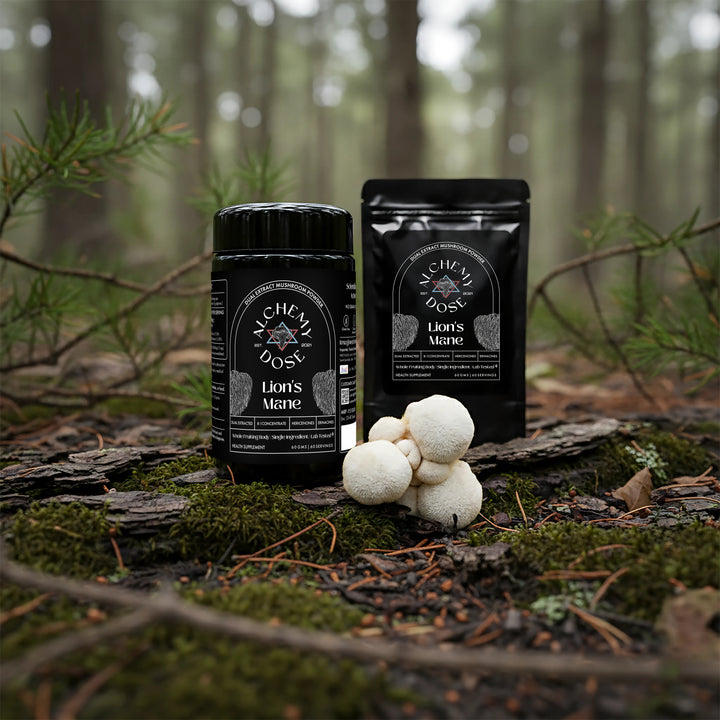
What Is Lion's Mane (Hericium erinaceus)?
Lion's Mane (Hericium erinaceus) is an unusual white mushroom that grows as a soft, rounded cushion covered in long downward-hanging spines, with no cap and no stem. It is a "tooth fungus", and those cascading white spines are where the lion's mane name comes from. Our Lion's Mane extract is made in India for the India market from the whole fruiting body, dual-extracted and lab-tested.
Our Lion's Mane mushroom extract is a concentrated powder made from the whole fruiting body of Hericium erinaceus, never mycelium grown on grain. It carries a published Certificate of Analysis, which most Lion's Mane sold in India does not.
Lion's Mane, Yamabushitake, Hou Tou Gu: The Many Names
Hericium erinaceusBotanical name
Lion's ManeEnglish common name
YamabushitakeJapanese, "mountain priest"
Hou Tou GuChinese, "monkey head"
Bearded ToothDescriptive name
Pom Pom BlancFrench name
What Is Inside Lion's Mane Extract
Lion's Mane is studied mainly for its compound chemistry. These describe what is in the mushroom, not what it does in the body.
Hericenones The fruiting-body compound
Hericenones are the compound class specific to the Lion's Mane fruiting body, first isolated in 1991. They are the compounds researchers most associate with Lion's Mane, and they are studied in the laboratory in relation to the nerve growth factor pathway.
Beta-D-Glucans & Polysaccharides Water-soluble
The water-soluble fraction is rich in beta-D-glucan and other polysaccharides, the broad compound family studied across functional mushrooms.
Triterpenoid Saponins Alcohol-soluble
Lion's Mane also carries triterpenoid saponins, which are fat-soluble, so an ethanol step is needed to capture them alongside the water-soluble compounds.
Lab-Verified Composition
From our Certificate of Analysis, batch BE20260201. 8:1 dual extract, whole fruiting body, no carriers.
26.20%Beta-Glucans
30.22%Polysaccharides
2.11%Triterpenoid Saponin
Why We Dual-Extract Our Lion's Mane
Lion's Mane holds two kinds of compounds that will not come out the same way. A single hot-water brew pulls only half of them.
Hot Water Step
Pulls out the water-soluble beta-D-glucans and polysaccharides.
Ethanol Step
Pulls out the fat-soluble hericenones and triterpenoid saponins that water leaves behind.
Our Lion's Mane is an 8:1 dual extract, hot water plus ethanol, so both fractions end up in the powder. Eight kilograms of raw Lion's Mane go into one kilogram of finished extract.
Fruiting Body, Never Mycelium
This matters more for Lion's Mane than almost any other mushroom. Hericenones live in the fruiting body, the white spined mushroom itself. A different compound group, erinacines, is found only in the mycelium, the root-like network grown on grain that many cheaper products actually sell. Because we use the whole fruiting body and never mycelium on grain, our extract carries the hericenones and none of the grain starch that comes with a mycelium shortcut.
How to Take Lion's Mane Extract
Stir 1 to 2 grams of extract powder into hot water, coffee, tea, or a smoothie. Lion's Mane has a mild, savoury, faintly seafood-like taste, which is why some people cook with it too. It is caffeine-free and has no fixed time of day, so it fits a morning coffee or an afternoon cup equally well. Many people take it daily and give it several weeks.
Lion's Mane and the Mountain Monks
In Japan, Lion's Mane is called yamabushitake, the "mountain priest mushroom", named after the Yamabushi ascetic monks who reportedly carried the dried mushroom on long mountain pilgrimages. In China it is hou tou gu, the "monkey head mushroom", recorded in the classical Compendium of Materia Medica of 1596, and it is still cooked as a food across East Asia. We share this as history and culture, not as a health claim.
Lion's Mane: Quick Answers
What is Lion's Mane mushroom?
Lion's Mane (Hericium erinaceus) is a white, spined "tooth fungus" that grows as a rounded cushion with no cap or stem. It is both a culinary mushroom and one of the most researched functional mushrooms, studied for its hericenone and beta-glucan compounds.
Where can I buy Lion's Mane in India?
Right here. Our Lion's Mane extract is made for the India market, dual-extracted from the whole fruiting body, and ships across India with a published Certificate of Analysis, which most Lion's Mane sold in India does not carry.
What is the difference between fruiting body and mycelium Lion's Mane?
The fruiting body is the actual white spined mushroom and holds the hericenones. Mycelium is the root-like network, often grown on grain, and it carries different compounds plus leftover starch. We use the whole fruiting body only.
How do you take Lion's Mane powder?
Stir 1 to 2 grams into hot water, coffee, tea, or a smoothie once a day. It is caffeine-free with a mild savoury taste, and most people give it several weeks of daily use.
Is Lion's Mane safe?
For most healthy adults Lion's Mane is well tolerated, and it has a long history as a food in Japan and China. If you are pregnant or breastfeeding, or are on any medication, speak to a doctor before regular use.
Lion's Mane is a food and is not for medicinal use. It is not intended to diagnose, treat, cure, or prevent any disease. If you are pregnant or breastfeeding, or are on any medication, consult a doctor before use. Marketed by Nutradose Private Limited under FSSAI License No. 13326999000107.
Composition references (identity only): Kawagishi et al., first isolation of hericenones from the Hericium erinaceus fruiting body, 1991. Compound identity and Certificate of Analysis values (beta-glucans 26.20%, polysaccharides 30.22%, triterpenoid saponins 2.11%) per batch BE20260201. Hericium erinaceus has over 1,500 published papers on PubMed.