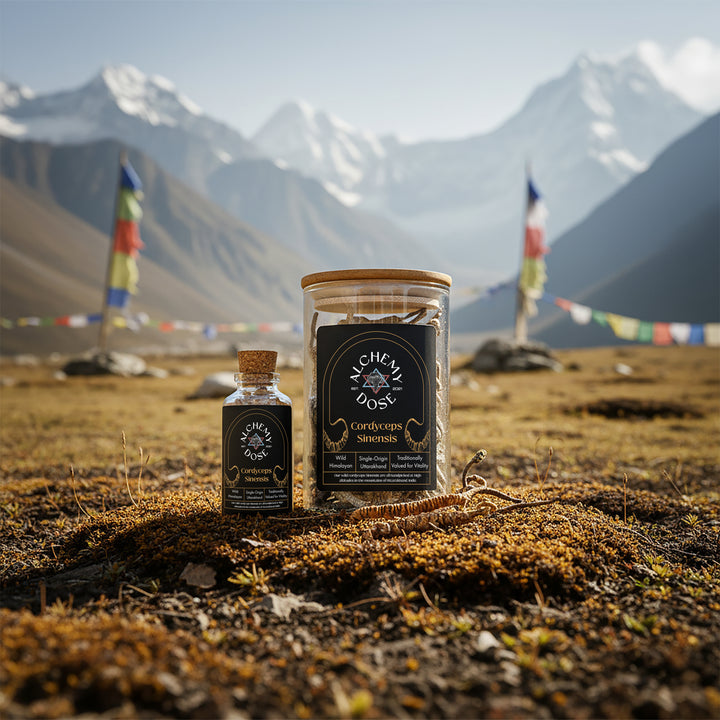


Wild Himalayan Cordyceps Sinensis (Keedajadi / Yarsagumba)
Choose your grade
Same wild Keedajadi in every grade. Only the piece size differs. Bigger pieces are rarer, so cost more.
About 500 mg = 1 Collector piece, or 1.5–2 Select pieces, or 2.5–3 Classic pieces.
Choose your dose
Qty

You're ₹105 away from a free Cordyceps militaris
Free Cordyceps militaris unlocked
Added at checkout · Worth ₹1,350
Also known as Kira Jari and Yarsagumba, this whole wild caterpillar fungus has been valued in Tibetan and Chinese wellness traditions for centuries. Hand-collected by Bhotiya and Garhwali foragers at 11,000 ft / 3,500 m in Uttarakhand, during the brief May to June season only. Keeda jadi (kira jari) price is set per gram, by grade.
WHY CHOOSE WILD KEEDA JADI
-
1Wild-Harvested at 11,000 ft / 3,500 mHand-collected by traditional Uttarakhand foraging communities in the high Himalaya, across the Pithoragarh and Chamoli districts.
-
2Centuries of Cultural HeritageDocumented in classical Tibetan and Chinese wellness traditions, and in Bhotiya and Garhwali foraging practice across the high Himalaya.
-
3Brief May to June Harvest WindowHand-foraged from alpine meadows above the tree line during a 4 to 6 week window, once a year.
-
4Whole Caterpillar-Fungus FormThe whole caterpillar fungus, not an isolated extract, with its naturally occurring polysaccharides, adenosine, and D-mannitol.
Wild Himalayan Keedajadi (Ophiocordyceps sinensis) here — a different species from cultivated militaris. Also available as a concentrated 8:1 Cordyceps militaris extract, and whole dried Cordyceps militaris.
- Prices mentioned are MRP (inclusive of all taxes)
- Worldwide shipping
- In stock, ready to ship

Suggested use
Used whole, not powdered. Rinse the strands briefly under cool water before use.
As an infusion. Simmer 1-2 strands in about 200 ml of water on low heat for 10 to 15 minutes and drink warm. The same strands can be simmered a second time, and are traditionally eaten afterwards rather than discarded.
In cooking. Add at the start of a stew, broth, soup or dal and let them cook through. A long, low simmer suits the strand better than a hard boil.
Do not boil hard. Do not microwave.
Storage
Store in a cool, dry place away from direct sunlight and heat. Keep the container tightly closed, since moisture is what spoils a dried strand. Do not freeze. Use within 24 months.
Introduction
Keedajadi (keeda jadi, कीड़ा जड़ी) is the Indian name for Ophiocordyceps sinensis, the wild Himalayan caterpillar fungus sold worldwide as Cordyceps sinensis. In Nepal it is yarsagumba (यार्सागुम्बा). In Tibet it is yartsa gunbu. Each piece is a whole wild strand: the mummified ghost moth larva with the dark club-shaped fruiting body still attached. Wild-collected only. This species has never been commercially farmed.
Origin
First described as Sphaeria sinensis by Miles Joseph Berkeley in 1843, moved to Cordyceps sinensis by Pier Andrea Saccardo in 1878, and reclassified as Ophiocordyceps sinensis in 2007. The earliest written description is a fifteenth century Tibetan text; the Chinese record begins in 1757. Wild keedajadi grows only in alpine grassland between 3,000 and 5,000 metres: the bugyals of Uttarakhand, Himachal Pradesh and Sikkim in India, and across Nepal, Bhutan and the Tibetan Plateau.
Harvesting
The Indian yarsagumba season runs April to June, after snowmelt and before the meadow grass grows tall enough to hide the stroma. Collectors work on hands and knees, because a mature keedajadi strand stands only a few centimetres above dark soil. Every strand is lifted with the larva intact, then hand-sorted and graded by piece count per gram. Wild Himalayan cordyceps cannot be farmed to order, so supply is set by season and altitude.