Until recently this page made a health claim for every one of the five mushrooms in our coffee, and one more for the L-theanine. We could not substantiate a single one of them.
So this is a myth-busting article that includes our own myths. Fair is fair.
What Mushroom Coffee Is
Mushroom coffee, sometimes written shroom coffee, is coffee with mushroom extract added. That is the entire definition. Everything else is a brand decision.
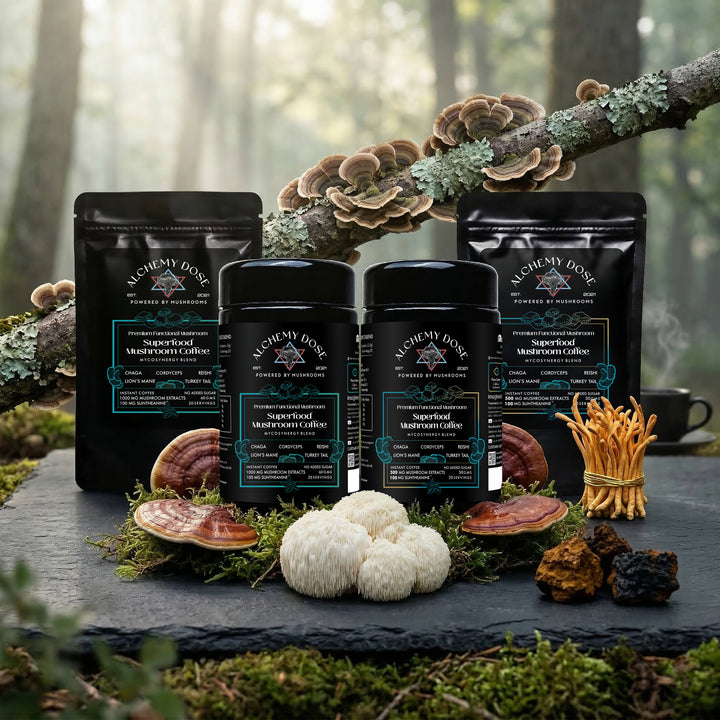
Ours is premium Indian Arabica with a five-species fruiting-body extract blend, at 500mg or 1000mg per serving, and 100mg of Suntheanine®, the patented L-theanine. Others use a single species, usually Lion's Mane. Some use ground beans, some instant. Some use fruiting body, and a great many use mycelium grown on grain, which is not the same thing at all.

Instant Arabica, five mushroom fruiting-body extracts, 100mg Suntheanine per serving
Myth 1: It Tastes Like Mushrooms
Myth"Mushroom coffee tastes like a bowl of mushroom soup."
What is true
It does not. Extracted mushroom powder is not the same as a mushroom, and at the dose used it contributes an earthy, slightly nutty depth rather than a flavour of its own.
What you taste is coffee, rounded off. Reishi adds a faint bitterness, which is why blends that use a lot of it can taste medicinal. Chaga and Lion's Mane lean nutty. Cordyceps is clean and earthy. Turkey Tail is nearly silent.
If a mushroom coffee tastes strongly of mushroom, the extract is poor, or there is a great deal of ground mushroom in there rather than extract.
Myth 2: It Is Psychedelic
Myth"Mushroom coffee will make you feel something."
What is true
Psilocybin comes from Psilocybe, a completely separate genus of fungi.
Lion's Mane, Cordyceps, Reishi, Chaga and Turkey Tail contain no psilocybin, no psilocin, and nothing psychoactive whatsoever. They are as unrelated to Psilocybe as an oak is to a cactus.
The only psychoactive substance in a cup of mushroom coffee is caffeine, and it was in your coffee long before the mushrooms arrived.
Myth 3: There Is No Real Coffee In It
Myth"Mushroom coffee is a coffee substitute."
What is true
Some are. Chicory and dandelion blends exist and they are not coffee.
Ours is premium Indian Arabica, instant, with extract added. Not a substitute, not a blend with barley, not decaffeinated. It is coffee, and it will behave like coffee.
Read the ingredient list. If coffee is not first, it is not coffee.
Myth 4: It Is Unsafe
Myth"Mushroom coffee is risky."
What is true, and where the real cautions are
For most adults it is coffee, and the safety conversation is the coffee safety conversation. But "generally safe" is a lazy answer, so here are the actual considerations, which most sellers omit.
- It contains caffeine. Not recommended for children, and pregnant women should follow their doctor's caffeine guidance.
- Chaga is high in oxalates. Anyone with kidney disease or a history of kidney stones should avoid it.
- Reishi and anticoagulants. Speak to a doctor if you take blood-thinning medication.
- Mould and fungal allergy. Avoid.
- Giesbrecht 2010, one of the L-theanine trials cited below, reported a small increase in systolic blood pressure with the caffeine and L-theanine combination.
Any brand telling you there are no considerations at all has not read the literature either.
Myth 5: The Calm-Energy Claim
Ours"Calm energy. None of what ordinary coffee does to you."
Why we stopped saying it
Because it is a comparison, and we have never run the comparison.
Every phrasing of it means better than something else. To say that, we would need a trial of our coffee against ordinary coffee, at the same caffeine dose, measuring the same outcome, in people. Nobody has run that trial. Not us, and not any brand selling you the phrase.
An implied comparison is still a comparison. We could not stand behind it, so we took it down.
Myth 6: It Has Less Caffeine
Ours"Mushroom coffee has less caffeine than regular coffee."
What we actually know
A two-and-a-half to three gram serving of instant coffee typically contains somewhere between sixty and eighty milligrams of caffeine. Typically.
We have not measured the caffeine in our own serving. Until we have, we are not going to call it low-caffeine, and neither should anybody who has not run the assay. "Moderate" is the honest word. When the number exists, it goes on this page.
What is true is that mushroom extract displaces some coffee by weight. Whether that is enough to matter is an empirical question, and we would rather answer it than assert it.
Myth 7: The Mushrooms Are the Active Part
Myth"The mushrooms are what makes mushroom coffee work."
What is true
Of everything in the cup, exactly one component has been through repeated double-blind placebo-controlled trials at close to the dose used. It is not a mushroom. It is the L-theanine.
Owen 2008, a crossover trial in 27 people, gave 100mg L-theanine with 50mg caffeine and found improved speed and accuracy on an attention-switching task and reduced susceptibility to distraction, against placebo.
Giesbrecht 2010, in 44 people, gave 97mg with 40mg caffeine and reported better task-switching accuracy, higher self-reported alertness, and lower self-reported tiredness. It also reported the small blood-pressure rise mentioned above.
Our Suntheanine dose is 100mg, which sits on that window almost exactly. That is a statement about a dose, not a promise about an outcome.
Both trials were funded by Unilever R&D, which produces tea-based beverages. We tell you so you can weigh them.

100mg Suntheanine. The dose Owen 2008 and Giesbrecht 2010 tested alongside caffeine
Myth 8: The Synergy Is Proven
Ours"Our proprietary blend enhances the bioavailability and effectiveness of the extracts."
There is one paper, and it is not about us
Mallard 2019 found that a rationally combined mushroom formulation produced an effect on human macrophages in cell culture that exceeded the sum of the individual extracts.
Three things about it. It was cells in a dish, not people. The blend was Reishi, Shiitake and Maitake, which is not our blend. And two of the authors were employed by the company sponsoring a competing formulation.
It supports the principle that combining mushrooms can behave differently from taking them alone. It says nothing at all about MycoSynergy, and the sentence about bioavailability has been removed from this page.
Myth 9: All Mushroom Coffee Is the Same
Myth"Mushroom coffee is mushroom coffee. Buy the cheapest."
The three questions that separate them
Fruiting body, or mycelium on grain? Mycelium is grown on rice or oats and cannot be separated from it. A large fraction of that powder, often most of it, is starch. Look for "myceliated grain", "full-spectrum", or an ingredient list naming rice.
Beta-glucans, or polysaccharides? Starch is a polysaccharide. A product made largely of ground rice can honestly report a high polysaccharide figure. Beta-glucans is the number that describes the fungus.
Does the per-mushroom maths add up? Some labels print a neat milligram split across species. Add them. If the total does not match the headline dose, or a species is missing from the list, you have learned something.

Fruiting body. Never mycelium grown on grain
What We Removed From This Page
An earlier version of this article carried the following. Every line has been taken down.
| What it said | Why it is gone |
|---|
| Lion's Mane, framed as acting on the mind | The human literature on this species is small and short, and would not carry it |
| Chaga and Turkey Tail, framed as acting on the body's defences | Not substantiated. Not something a food may promise |
| Reishi, framed as acting on mood | Not substantiated |
| Cordyceps, framed as acting on physical output | Not substantiated |
| Suntheanine, framed as acting on mood, and on sleep | Not substantiated, and a sleep line has no business on a caffeinated product |
| "Clinically proven" and "scientifically proven ingredients" | Neither the blend nor the coffee has ever been in a clinical trial |
| "Seven science-backed benefits of L-theanine" | There are a handful of trials. Both of the ones we cite were industry-funded, and we say so |
| "Enhances bioavailability and effectiveness" | Asserted, never measured. See Myth 8 |
Every one of them was easy to write and impossible to defend. That is usually the tell.

Resealable Dose Bag, or the biophotonic jar that keeps light off the extract
Why Mushroom Coffee Costs What It Costs
Mushroom coffee is expensive, and cheap mushroom coffee is expensive for different reasons. Three things drive the number on the pack.
Suntheanine®, which most blends do not contain
L-theanine is an amino acid found in tea. It exists in two mirror-image forms, and cheap bulk L-theanine is often a mixture of both. Suntheanine® is a patented ingredient made by Taiyo, produced through enzymatic fermentation rather than extraction, and it is over 99 percent the pure L-isomer.
It is also, by a distance, the most expensive thing in our cup. We use 100mg per serving, in both strengths, because that is the dose the two trials below actually tested. Most mushroom coffees contain no L-theanine at all. Some contain a token amount of the bulk grade. Read the pack.
The mushrooms are what the category is named after. The Suntheanine is what the price is made of.
Fruiting body, not mycelium on grain
Growing mycelium on rice takes weeks and cannot be separated from the rice. Growing a fruiting body takes months. That difference shows up on every price tag in this category, and it is the single largest reason one mushroom coffee costs three times another.
A coffee base worth drinking
Premium Indian Arabica, instant. Not a robusta filler, not chicory, not barley.
500mg or 1000mg?
Two strengths of the same blend. Same coffee, same 100mg of Suntheanine® in each. Only the mushroom extract total changes.
| | 500mg Essential | 1000mg Optimal |
|---|
| Mushroom extract, per serving | 500mg | 1000mg |
| Suntheanine® | 100mg | 100mg |
| Coffee | Premium Indian Arabica, instant |
| Suits | More than one cup a day, or a gentler start | A single, stronger cup |
Both come in five sizes, from a five-serving trial pack to fifty servings, and in two packagings: a resealable Dose Bag, or a biophotonic UV glass jar, which ships with five extra servings and keeps light off the extract.
The trial pack exists because we cannot tell you which strength you want, and neither can anybody else. Five cups will.
How to Make It
One level teaspoon into hot water or milk: 2.5g at 500mg strength, 3g at 1000mg. It dissolves. For a cold drink, froth it, because instant coffee and cold water are not natural friends.
One to three cups a day, and treat the third one the way you would treat a third coffee.

One teaspoon, three grams, hot or cold. Stir or froth until smooth
Frequently Asked Questions
Does mushroom coffee taste like mushrooms?
No. It tastes like coffee with an earthy, slightly nutty depth. Reishi contributes a faint bitterness. If a mushroom coffee tastes strongly of mushroom, the extract is poor or it contains ground mushroom rather than extract.
Does mushroom coffee have caffeine?
Ours does. It is instant Arabica coffee. A two-and-a-half to three gram serving of instant coffee typically contains sixty to eighty milligrams of caffeine, though we have not yet published a measured figure for our own.
Is mushroom coffee psychedelic?
No. Functional mushrooms contain no psilocybin and nothing psychoactive. Psilocybin comes from an entirely unrelated genus of fungi.
Is mushroom coffee safe?
For most adults, as safe as coffee. It contains caffeine, so it is not for children, and pregnant women should follow their doctor's caffeine guidance. Chaga is high in oxalates and unsuitable for people with kidney disease. Anyone on anticoagulant medication should speak to a doctor first.
What is the best mushroom coffee in India?
We would rather tell you how to judge one. Ask whether the mushrooms are fruiting body or mycelium on grain, ask for the beta-glucan figure rather than the polysaccharide figure, and add up the per-mushroom milligrams to see whether they reach the headline dose.
MycoSynergy Mushroom Coffee
Instant Arabica with five mushroom fruiting-body extracts at 500mg or 1000mg per serving, and 100mg of Suntheanine, the dose Owen 2008 and Giesbrecht 2010 tested. No promises attached.
See MycoSynergy →