Erwin founded Alchemy Dose to source functional mushroom extracts from the producers who make them best, wherever in the world that is, alongside wild mushrooms foraged in the Himalaya, and to formulate his own products from them. The aim is high-quality extracts, tested per batch, and honest products built on top of them. He writes about mushroom chemistry, how an extract is actually made, and how to read a certificate of analysis rather than a label.
Updated 30 October 202612 min readBuyer's guide
Type "best mushroom coffee" into Google and you get a wall of tins, pouches and jars, each one calling itself premium. None of them can tell you which one is right for you, because "best" depends on what you want in your cup. What you can do is read the label like a buyer. This guide gives you six checks that work on any mushroom coffee sold in India, a price calculator loaded with real prices, and a 30-second scorecard. We run our own coffee through the same checks at the end.
The short answer
What to look for
Named mushrooms, milligrams per cup split by species, fruiting body stated in writing, an extract with its method, a clear coffee base and caffeine figure, and a fair price per cup.
Biggest red flag
"Mushroom blend" with one total weight and no breakdown, or no milligrams at all.
Best way to start
A small trial pack, so you learn the taste and how it mixes before buying a month's supply.
The six checks work on any pack, in any shop. Save this one.
What mushroom coffee actually is
Mushroom coffee is ordinary coffee with a powdered mushroom extract mixed in. Most versions sold in India use instant coffee as the base, so you stir a spoonful into hot water or milk the same way you would any instant coffee.
The mushrooms in it are not the ones in your sabzi. They are species with a long history in East Asian tradition, dried, extracted and ground into a fine powder. When made well, the powder dissolves into the coffee and most people taste coffee first.
That last part matters. You cannot see or taste the mushroom, so the label is the only thing that tells you what you are paying for.
Check 1: Are the mushrooms named?
Start with the ingredient list. A clear label names every mushroom in the blend. A vague one says "mushroom blend", "functional mushroom complex" or "superfood mushrooms" and stops there.
Names matter because each species is a separate fungus with its own tradition and its own compounds. If a pack does not say which ones are inside, you cannot look any of them up, and you cannot compare one product with another. A good sign is the Latin name next to the common one. It shows the maker knows exactly which species they bought.
Common name
Latin name
What it looks like
Lion's Mane
Hericium erinaceus
A white, shaggy ball of soft spines
Cordyceps
Cordyceps militaris
Thin, bright orange clubs
Reishi (lingzhi)
Ganoderma lucidum
A glossy, red-brown, kidney-shaped shelf
Chaga
Inonotus obliquus
A black, cracked lump that grows on birch trees
Check 2: How many milligrams per cup?
This is the check most buyers skip, and it tells you the most. Look for the amount of mushroom extract in one serving, written in milligrams (mg).
Some labels list a "proprietary blend" with one total weight and no breakdown. That is legal, but it means you cannot tell how the total splits across the species. Two packs can both print 1,000 mg and hold very different cups.
Each colour is one mushroom. Illustration, not real products. One total weight can hide how it splits, so ask the brand for the split.
Then do the simple math. If a 100 g pack holds 30 servings and the label says 1,000 mg of mushroom per serving, that is 30 g of mushroom in a 100 g pack. If the numbers do not add up, the label is not telling you the whole story.
How ours reads
MycoSynergy prints the split: 125 mg of each of four mushrooms in the 500 mg strength, or 250 mg of each in the 1,000 mg strength. See the label on the product page.
Check 3: Fruiting body or mycelium on grain?
A mushroom has two main parts. The fruiting body is the part you can see and pick, the cap and stem. The mycelium is the thread-like network that grows underneath, a bit like roots. Both are real parts of the fungus. The trouble is not the mycelium itself. It is what the mycelium is usually grown on, and what ends up in the powder with it.
To see why, you need two words that appear on every good lab report: beta-glucan and starch.
First, what a mushroom powder is made of
Both a grain of rice and a mushroom are built from long chains of glucose, the plain sugar your body runs on. The difference is the joint between the beads of the chain.
Starch is the glucose chain in rice, oats, wheat and potatoes. Its beads are joined with an "alpha" link. Your gut opens that link easily, so starch becomes sugar and then energy. It is food, and nothing more than food.
Beta-glucan is the glucose chain in the cell walls of mushrooms and yeast. Its beads are joined with "beta" links, in a branched 1,3 and 1,6 pattern. Your gut cannot open that link, so beta-glucan passes through as a fibre. It is the compound most mushroom research measures, and the number a serious extract is standardised to.
Why the lab method matters: starch and beta-glucan are both glucose chains, so a total polysaccharide number lumps them together.
How each powder is made
A. Fruiting body. The mushroom grows out of a block of sawdust or grain. When it is ready, it is cut off and the block stays behind. Only the mushroom is dried and made into an extract, so what goes in the jar is mushroom.
B. Mycelium on grain. Mycelium is the root-like part of a fungus. It is made of thin white threads. To grow it, cooked and cleaned rice or oats go into a jar with a little mycelium. Over a few weeks, the threads spread through the grain and feed on it, a bit like yeast working through dough. This slow growing on solid food is called solid-state fermentation. By the end, the threads and the grain are knotted together, so the whole jar is dried and milled into one powder.
Both are real fungus, and both are made this way on purpose. Neither is a trick. What matters to you as a buyer is that the label says which one is in the pack, because the two powders hold different things.
In B, the grain is not taken out. It is milled in with the threads, so both count toward the "mushroom" weight on the pack.
One case to know: Cordyceps militaris fruiting bodies also grow in jars of grain, but only the orange clubs are cut off and the grain stays behind. So it is the part used that matters, not what it grew on.
What the grain adds to the powder
The threads eat some of the grain as they grow, but not all of it. What is left gets milled into the powder, and grain is mostly starch. So a mycelium-on-grain powder holds two things: fungus threads, and the leftover grain they grew on. Both count toward the "mushroom" weight on the label.
You do not have to guess how much is which. A lab can measure it. A method published in 2016 in the Journal of AOAC International breaks a powder down into total glucan, then measures the starch (alpha-glucan) on its own, and takes beta-glucan as the difference. The same paper ran the method on dried whole mushrooms and on capsules of mushroom products bought online. Here is what it found.
Starch is the grain's signature. A high starch number next to a low beta-glucan number means the powder is mostly the growing bed.
On the evidence
McCleary BV, Draga A. Measurement of beta-glucan in mushrooms and mycelial products. Journal of AOAC International, 2016;99(2):364-373, doi 10.5740/jaoacint.15-0289. Peer-reviewed method paper. The whole mushrooms were supplied by a commercial grower of fruiting bodies and the capsules were bought from an online retailer in 2015, so read the product figures as examples of a pattern, not as a survey of today's market. The numbers above are for whole dried mushrooms, not extracts; an extract concentrates them.
What to ask for
Two plain questions settle it. Does the label say "fruiting body", "mycelium", or neither? And if the brand shares lab numbers, is there a beta-glucan figure, or only a "polysaccharides" figure? Polysaccharides is the family name for every glucose chain, starch included, so on its own it does not tell you much. We walk through a real lab report line by line in our beta-glucans label guide, and go deeper on one species in Lion's Mane: fruiting body vs mycelium.
A quick label tip
Words like "full spectrum" or "whole mushroom" do not tell you which part was used. Look for the plain words fruiting body or mycelium, and watch for "myceliated rice", "myceliated oats" or "oat flour" in the ingredients.
Check 4: Is it an extract, and how was it made?
Dried mushroom powder and mushroom extract are not the same thing. Mushroom cell walls are made of chitin, a tough material people do not break down well. Extraction uses hot water, and sometimes alcohol too, to draw the compounds out into a form you can use.
Hot water extraction pulls out polysaccharides such as beta-glucans. A second alcohol step, called dual extraction, draws out compounds that do not dissolve in water, such as the triterpenes in reishi.
A clear label or product page tells you whether the mushroom is an extract and which method was used. Some makers also share a certificate of analysis (COA), a lab report for the batch. If you get one, look for four lines: beta-glucan (not just polysaccharides), starch, heavy metals, and microbial counts.
Check 5: The coffee, and what else is in the cup
It is still coffee, so look at the coffee too. Is it Arabica, Robusta or a mix? Is it instant, ground or freeze-dried? Instant is the most common in mushroom coffee because the powder blends evenly with it.
Caffeine comes from the coffee, not the mushrooms. You can estimate it yourself from the amount of coffee in a serving.
"Low caffeine" on a pack means nothing without a number. Ask for the mg.
Then read the rest of the list. Some blends add sugar, creamer, flavourings or fillers to bulk up the pack. Others add one functional ingredient on purpose. L-theanine is a common one. It is an amino acid found naturally in tea leaves, and it has been studied together with caffeine.
Researchers gave people 100 mg L-theanine with 50 mg caffeine and then tested them on attention-switching tasks. Compared with placebo, the pairing improved speed and accuracy on those tasks at 60 minutes. The study was funded by Unilever R&D, which makes tea drinks. It tested the pairing, not any mushroom coffee.
Source Owen GN et al., Nutritional Neuroscience, 2008, PMID 18681988
If a blend adds L-theanine, check how much. Studies on the pairing used amounts near 100 mg. A few milligrams added for the label is not the same thing. More in our explainer, What is Suntheanine (L-theanine) in mushroom coffee?
Check 6: Price per cup, then per mg
Packs come in different sizes, so the pack price alone tells you little. Divide the price by the number of servings to get the price per cup. Then divide by the milligrams of mushroom from Check 2 to see what you pay for the mushroom itself. Here is the sum worked on our own 500 mg, 10-cup pouch, which is Rs.945 on the product page today: Rs.945 divided by 10 is Rs.94.50 a cup, and Rs.94.50 divided by 500 mg, times 100, is Rs.18.90 per 100 mg of mushroom.
Do the second sum on every pack you compare, because it turns the price table upside down. A bigger number on the shelf can be the cheaper cup, and a stronger pack can be the cheaper milligram. Our own range shows both.
The 1,000 mg pack costs more per cup and less per milligram of mushroom. Which one is "cheaper" depends on which number you care about.
Try it with any pack you are looking at. Pick one of ours from the list, or type in the numbers from any label.
Price per cup calculator
Rs.94.50per cup
Rs.18.90per 100 mg mushroom
Pouch prices, before the first-order discount. If a pack lists no mg, the second box cannot be worked out, and that tells you something too.
Score any pack in 30 seconds
Pick up a pack, or open a product page, and tick what it tells you. You do not need to trust any brand. You only need to read.
The six-check scorecard
0 of 6Tick what the label tells you.
How MycoSynergy answers the six checks
We built MycoSynergy Mushroom Coffee so that each of these checks has a plain answer. Here it is, check by check.
MycoSynergy, check by check
1. Mushrooms named
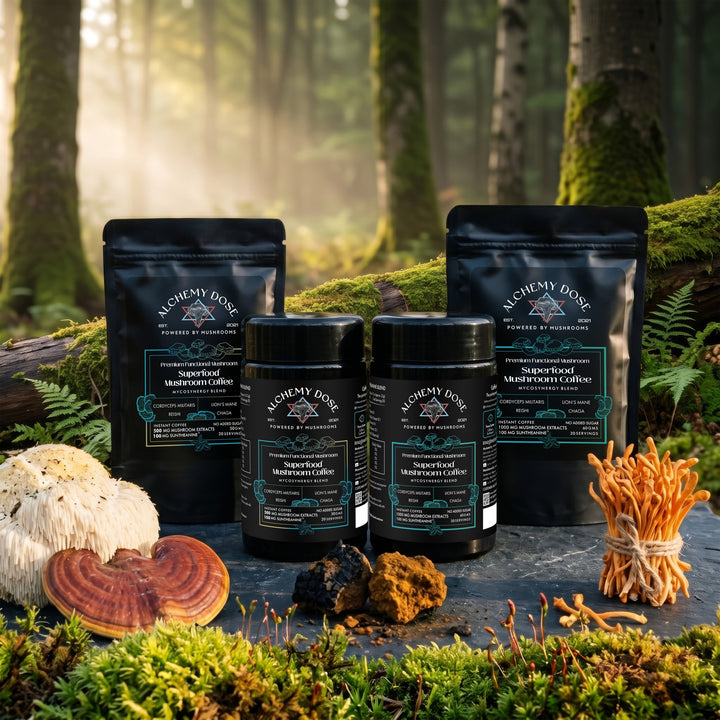
Four: Lion's Mane (Hericium erinaceus), Cordyceps militaris, Reishi (Ganoderma lucidum) and Chaga (Inonotus obliquus)
2. Mg per cup
500 mg (125 mg of each mushroom) or 1,000 mg (250 mg of each), in equal parts
3. Part used
Fruiting body. No mycelium on grain.
4. Extraction
Extracts, not raw powder. Lab-tested per batch in India.
5. Coffee and extras
Instant Indian Arabica, 100 mg Suntheanine (L-theanine) per cup, no added sugar, no creamer, no fillers
6. Price per cup
500 mg: Rs.105 a cup on the 5-cup trial (Rs.525), Rs.94.50 on the 10-cup pouch (Rs.945). 1,000 mg: Rs.135 a cup on the trial (Rs.675) and the 10-cup pouch (Rs.1,350). Prices from the product page, 30 October 2026.
One level teaspoon goes into hot water or milk, or is pasted with a little hot water first for an iced coffee. If you are weighing a four-mushroom blend against a coffee built around one mushroom, we compared the two in MycoSynergy vs single-mushroom coffee. If you drink tea more than coffee, our Ceremonial Matcha blend pairs fruiting-body extracts with the same 100 mg of Suntheanine. And if you are still deciding whether mushroom coffee belongs in your routine at all, our functional mushrooms guide for India starts from zero.
What is fair to say
A label can name every mushroom and its mg per cup.
Fruiting body and mycelium on grain are different raw materials, and a lab can tell them apart by measuring starch and beta-glucan.
L-theanine with caffeine has been tested in human trials.
Price per mg is a better yardstick than price per pack.
What no one can claim
That any mushroom coffee treats or prevents a health condition.
That a blend was tested in a trial when only one ingredient was.
That one brand is "the best" for everyone.
That a cup replaces a varied diet or medical advice.
Where to buy
The full range, both strengths and every pack size, is on alchemydose.com, with free shipping across India. A first order gets 20% off: 10% comes off automatically, and the code WELCOME10 takes off another 10%. The 1,000 mg 5-cup trial is also on Amazon.in.
Frequently Asked Questions
Which is the best mushroom coffee in India?
There is no single best one for everyone. The right one for you names every mushroom, lists the mg per cup, says whether it uses fruiting body or mycelium, and gives you a fair price per cup. Use the six checks and the scorecard in this guide to compare any two packs side by side.
Does mushroom coffee taste like mushrooms?
Usually not. A well-made extract is a fine powder that dissolves into the coffee, so most people taste coffee first. Some notice a slightly earthy finish, which milk or a little sweetener softens.
How much caffeine is in mushroom coffee?
It depends on how much coffee is in a serving. Instant coffee averages about 31 mg of caffeine per gram in USDA data, so a cup made with 2 g of instant coffee holds roughly 40 to 90 mg depending on the beans. The mushrooms add no caffeine.
What is the difference between fruiting body and mycelium?
The fruiting body is the cap and stem of the mushroom, the part you can pick. Mycelium is the thread-like network underneath. Mycelium for supplements is usually grown on grain, and the grain is milled into the powder, which shows up as starch in a lab test.
What is beta-glucan in mushroom coffee?
Beta-glucan is the fibre that makes up much of a mushroom's cell wall. It is a chain of glucose joined by beta links, which your gut cannot break into sugar. Grain starch is also a chain of glucose, but with alpha links, which your gut digests easily. A lab test that reports beta-glucan and starch separately shows whether a powder is mostly mushroom or mostly its growing bed.
Is mushroom coffee the same as mushroom powder in coffee?
Not always. Some products add dried, ground mushroom. Others add an extract made with hot water or alcohol. The label or product page should say which one, and which part of the mushroom was used.
How should I store mushroom coffee?
Keep it sealed, dry and away from heat, and use a dry spoon. Like any instant coffee, the powder pulls in moisture from the air and can clump once it gets damp.
How many cups of mushroom coffee can I have in a day?
Follow the serving on the pack and do not go over the daily amount printed on the label. For MycoSynergy that is one level teaspoon per cup. If you are pregnant, breastfeeding or taking medication, speak to a doctor first.
Run the six checks on ours
Four named mushrooms, mg per species on the label, fruiting body, 100 mg Suntheanine. Start with the 5-cup trial. First order? 10% comes off automatically, and WELCOME10 takes off another 10%, so 20% in all, on alchemydose.com.
NOT FOR MEDICINAL USE. The products described here are foods and are not intended to diagnose, treat, cure, or prevent any disease. They are not a substitute for a varied diet or for medical treatment. Follow the recommended usage level and do not exceed the recommended daily usage. If you are pregnant, breastfeeding, taking medication, or managing a health condition, consult a qualified healthcare practitioner before use. Marketed and sold by Nutradose Private Limited under FSSAI License No. 13326999000107.
MycoSynergy Mushroom Coffee, 4-Mushroom Blend with Suntheanine®
73 reviews
Regular price
Rs. 1,050.00Sale priceRs. 945.00
/
Inclusive of all taxes.
MycoSynergy mushroom coffee: instant Indian Arabica blended with 500mg or 1000mg of four fruiting-body mushroom extracts per serving, Lion's Mane, Cordyceps militaris, Reishi and Chaga in equal parts, plus 100mg of Suntheanine®, the single-isomer L-theanine used in published trials alongside caffeine. Most mushroom coffees contain none.
It tastes like coffee, not mushrooms: an earthy, slightly nutty depth in the cup. One level teaspoon per cup, hot, or pasted with hot water first for iced coffee. Available in 20-serving jars and a 5-serving trial pack at both strengths.
No added sugar, no creamer, no fillers, no mycelium on grain. FSSAI licensed and lab-tested per batch in India.
You're ₹1,455 away from a free Cordyceps militaris