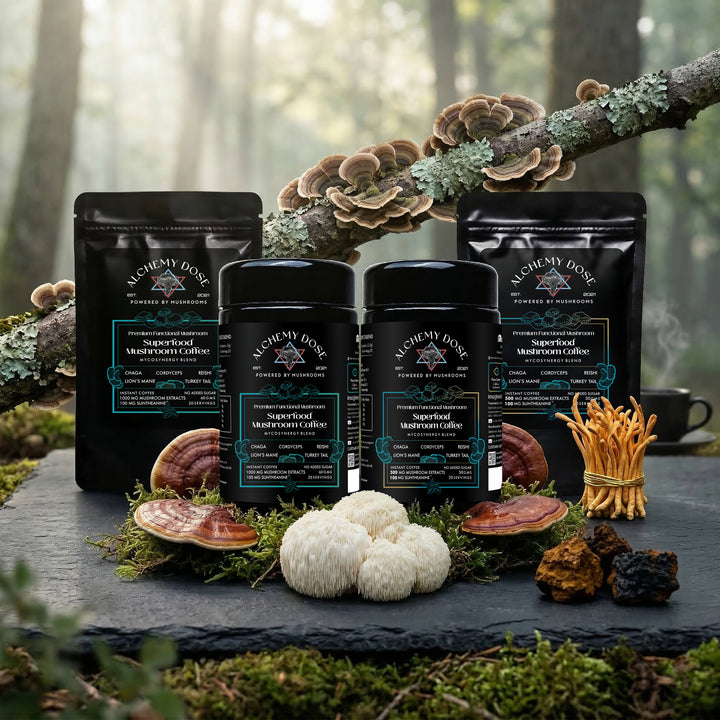
Search mushroom coffee in India and you will find two arguments. One brand sells a single-species Lion's Mane coffee and tells you focus is the point. Another sells a five-mushroom blend and tells you synergy is the point. Both are selling. Neither usually shows you the evidence.
We make the blend. Here is the honest version, including the part that favours the other side.

MycoSynergy: instant Arabica, five mushroom fruiting-body extracts, 100mg Suntheanine per serving
The Question
Is a coffee containing five mushroom extracts better than a coffee containing one?
Nobody knows. No randomised trial has compared a five-species mushroom coffee against a single-species mushroom coffee in human beings. Not ours, not theirs, not anyone's. Anybody who tells you otherwise is describing an intuition, not a result.
What can be answered is narrower and more useful. What is in each cup. What has been measured, and in whom. And what the trade-off actually is.
What Is in the Cup
MycoSynergy is instant coffee, 100 percent Arabica, with two things added.
- A five-species mushroom extract blend, at either 500mg or 1000mg total per serving. Lion's Mane, Cordyceps, Reishi, Chaga and Turkey Tail. Fruiting body, dual-extracted, never mycelium grown on grain.
- 100mg of Suntheanine, the patented L-theanine from Taiyo. Over 99 percent pure L-isomer, produced by enzymatic fermentation.
One teaspoon, three grams, hot or cold. No fillers, no seed oils, no added sugar.

Instant Arabica base, five mushroom fruiting-body extracts, 100mg Suntheanine per serving
A note on the maths
We publish the total mushroom extract dose per serving, not a per-mushroom breakdown. Some brands print a neat split across their species. Ours would be an estimate dressed as a measurement, so we do not print one. If a competitor's per-mushroom figures add up too neatly, ask how each was measured.
The One Tested Thing in This Cup
Of everything in a mushroom coffee, exactly one component has been through repeated double-blind placebo-controlled trials at close to the dose we use. It is not a mushroom. It is the L-theanine.
Human RCT
The combined effects of L-theanine and caffeine on cognitive performance and mood
Owen, Parnell, De Bruin & Rycroft. Nutritional Neuroscience, 2008. Double-blind placebo-controlled crossover, n = 27.
100mgL-theanine
50mgCaffeine
27Subjects
The combination improved both speed and accuracy on an attention-switching task at 60 minutes, and reduced susceptibility to distraction at 60 and 90 minutes, compared with placebo.
Source: Owen GN, et al. Nutr Neurosci, 2008;11(4):193-8. PMID: 18681988. Funded by Unilever R&D.
Human RCT
The combination of L-theanine and caffeine improves cognitive performance and increases subjective alertness
Giesbrecht, Rycroft, Rowson & De Bruin. Nutritional Neuroscience, 2010. Double-blind placebo-controlled, n = 44.
97mgL-theanine
40mgCaffeine
44Subjects
Significantly improved task-switching accuracy, higher self-reported alertness, and reduced self-reported tiredness against placebo.
The finding nobody quotes
The same paper reported a small increase in systolic blood pressure with the combination. We are including it because it is in the paper, and because you will not read it on a competitor's landing page.
Source: Giesbrecht T, et al. Nutr Neurosci, 2010;13(6):283-90. PMID: 21040626. Funded by Unilever R&D.
L-theanine dose, tested vs ours
Owen 2008100mg
Giesbrecht 201097mg
Haskell 2008250mg
MycoSynergy100mg
Our Suntheanine dose sits on the Owen and Giesbrecht window almost exactly. This is a statement about a dose, not a claim about an outcome. The MycoSynergy blend itself has never been in a clinical trial, and we will not pretend it has.

100mg Suntheanine per serving. The same L-theanine dose Owen 2008 and Giesbrecht 2010 tested alongside caffeine
What "Synergy" Actually Rests On
Every blend brand, ours included, likes the word synergy. It is worth knowing what is underneath it.
In Vitro
Synergistic immuno-modulatory activity in human macrophages of a mushroom formulation
Mallard, Leach, Wohlmuth & Tiralongo. PLoS One, 2019. Cell culture.
A rationally combined mushroom formulation produced an effect on human macrophages in culture that exceeded the sum of the individual extracts.
Three things about this paper
It was cells in a dish, not people. The blend it tested was Reishi, Shiitake and Maitake, which is not our blend. And two of the authors were employed by the company sponsoring a competing product.
It supports the principle that combining mushrooms can behave differently from taking them alone. It says nothing whatsoever about MycoSynergy. We cite it for the idea, and we will not stretch it further.
Source: Mallard B, et al. PLoS One, 2019;14(11):e0224740. PMID: 31697749
The Case for a Single-Mushroom Coffee
This is the part a blend brand is not supposed to write.
If you buy a Lion's Mane coffee and it contains 1000mg of Lion's Mane, you are getting 1000mg of Lion's Mane. If you buy a five-mushroom blend at 1000mg total, you are getting roughly a fifth of that, whatever the split.
So a single-species coffee is the right choice when:
- You want a specific species at a meaningful dose.
- You already know which one you respond to.
- You want to isolate one variable rather than five.
- You want to check the beta-glucan figure for one mushroom rather than reconcile five.
That is a real argument. It is the argument the single-species brands make with their Lion's Mane coffee, and it is not a bad one.
The Case for a Five-Mushroom Blend
And here is ours.
| | Single species | Five-species blend |
|---|
| Dose per species | High. All of it in one. | Lower. Shared across five. |
| Compound classes | One profile | Hericenones, cordycepin, triterpenoids, betulin, PSK and PSP |
| Requires you to know | Which species you want | Nothing |
| Evidence for the combination | Not applicable | One in-vitro paper, on a different blend |
| If you respond to one | You already found it | You will not know which |
| Suited to | A specific goal | A daily cup, indefinitely |
The blend is not a stronger version of a single mushroom. It is a different proposition. Five compound classes instead of one, at a lower dose each, for someone who wants a daily coffee rather than an intervention.

Five species, one cup

Fruiting body, never mycelium on grain
Nobody has proved that is better. We think it is more honest to say so than to invent a study.
Caffeine, Honestly
A two-and-a-half to three gram serving of instant coffee typically contains somewhere between sixty and eighty milligrams of caffeine. Typically. We have not published a measured figure for our own serving.
Until we have, we are not going to call this a low-caffeine coffee. "Moderate" is the truthful word. When the assay is done, the number goes on this page.
What Owen 2008 and Giesbrecht 2010 tested was a pairing: caffeine plus L-theanine, at 50mg and 40mg of caffeine respectively. Both doses are lower than a cup of ours. That gap is worth knowing too.
500mg or 1000mg?
Two formats, same Suntheanine, same coffee, different mushroom extract totals.
- 500mg Essential. For more than one cup a day, or a gentler start.
- 1000mg Optimal. For a single stronger cup.
The trial pack exists precisely because we cannot tell you which. Five servings, no commitment.
What We Will Not Say
Things you will not read here
- "No jitters, no crash." An implied comparison we cannot substantiate
- "Improves sleep." This is a caffeinated product
- "Boosts immunity." A disease-adjacent claim we cannot substantiate
- "Clinically proven." The blend has never been in a trial
- Percentage stats we cannot trace to a named paper
Things we will
- The species, all five, and the part of the fungus
- The total dose, 500mg or 1000mg, per serving
- The Suntheanine dose, 100mg, and the two trials that tested it
- The funding behind those trials
- The blood-pressure finding in Giesbrecht

One teaspoon, three grams, hot or cold. Stir or froth until smooth
How to Choose
Buy the single-mushroom coffee if you know which species you want and you want a real dose of it. That is a good reason and we would rather you were satisfied than sold to.
Buy the blend if you want a daily cup with five compound classes and a Suntheanine dose that sits where the trials sat, and you accept that no study has ever tested the combination.
Buy neither if a brand cannot tell you the species, the part of the fungus, the total dose, and the extraction method. Most cannot.
Further reading: what the word "adaptogen" actually means, and what the Cordyceps studies really show.