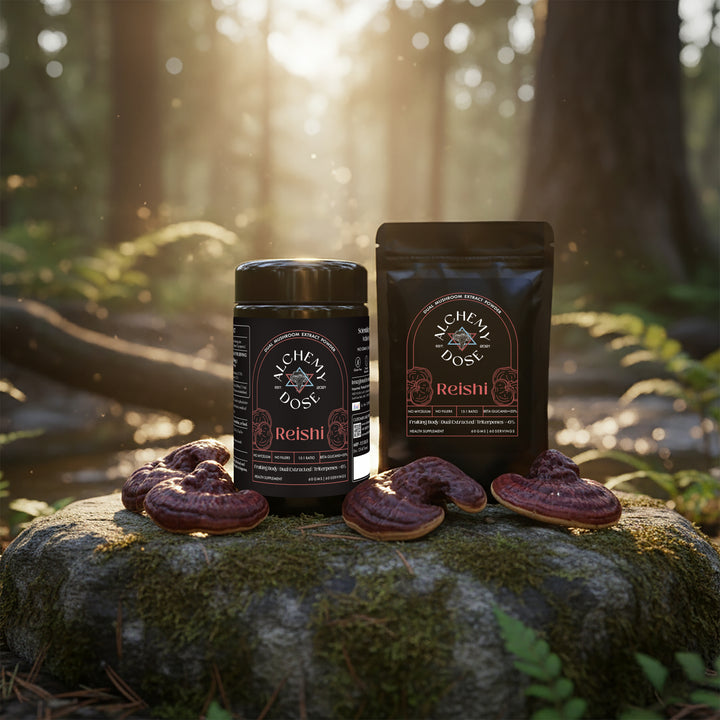
If you have shopped for reishi in India, you have probably met the same mushroom under three names without realising it. One label calls it Ganoderma. Another says reishi. An old Chinese text says lingzhi. It is one fungus wearing three names, and they cause a lot of confusion at the checkout. This guide is about the names, not about outcomes. It covers what the fungus is, which compounds sit inside it, and how to read a reishi label so the word on the front stops getting in your way.
Three names, one fungus
Ganoderma, reishi, and lingzhi are not three mushrooms. They are three names for one, and that catches out almost everyone who shops for it.
Ganoderma is the genus, the scientific family name. The species most people mean is Ganoderma lucidum, and that full Latin name is what a botanist or a lab would use. Reishi is simply the Japanese word for the same fungus. Lingzhi is the Chinese word for it.
There is a twist in India. Search interest here leans toward ganoderma far more than reishi. Many Indian shoppers first meet it as ganoderma, through coffee blends or older herbal shops, and only later learn reishi is the same fungus with a Japanese name. Modern wellness brands mostly print reishi, the word that travelled through the West. If you have compared a ganoderma product with a reishi product wondering which is better, you may have been comparing two jars of the same species.
Reishi is not the only fungus with a naming problem. Wild Himalayan cordyceps carries three names too, keeda jadi, yarsagumba, and Cordyceps sinensis, for the same reason: one organism crossing several languages and cultures.
The Naming Flip
Ganoderma is the genus. Ganoderma lucidum is the species. Reishi is what Japanese speakers call it. Lingzhi is what Chinese speakers call it. If a label carries any one of these, it is talking about the same fungus. In India most people type "ganoderma" into a search bar, while the wellness aisle usually prints "reishi." Both lead to the same place.
What reishi actually is
Reishi is a woody shelf mushroom. It grows on hardwood, often at the base of dead or dying trees, and forms a flat, kidney-shaped bracket that sticks out from the trunk. People call this shape a conk. The top has a hard, varnished surface that looks almost lacquered, which is where the species name lucidum, meaning shining, comes from.
Mature reishi is tough and corky, closer to wood than to a button mushroom, which is one reason it has almost always been prepared as a tea or an extract rather than eaten as food.
The part that matters for an extract is the fruiting body, the bracket itself. Our Reishi (Ganoderma) extract is made from the fruiting body only, as a dual extract at 15 to 1. Dual extraction means the dried mushroom is processed two ways, once with hot water and once with alcohol, and the two are combined. A 15 to 1 ratio means roughly fifteen kilograms of dried fruiting body go into every kilogram of finished extract.
Reishi at a glance
Latin name
Ganoderma lucidum
Also called
Reishi (Japanese), Lingzhi (Chinese), Ganoderma (common in India)
Part used
Fruiting body, the woody bracket or conk
Our extract
Dual extract (water and alcohol), 15 to 1, fruiting body only
Triterpenes
Ganoderic acids measured at 6.13%, the highest in our range
Beta-glucans
Measured at 20.07%
Polysaccharides
Measured at 25.11% total
Testing
Lab-tested per batch in India
The compounds people mean
When people talk about reishi, they usually mean a few groups of compounds that chemists have measured in the fruiting body. Those compounds show up on labels, and once you can name them the label reads more clearly.
The first group is the triterpenes, and within them a family called ganoderic acids. These are the bitter compounds in reishi. In our extract, triterpene content is 6.13 percent, the highest in our range. Triterpenes are also the compounds most often used to tell true fruiting-body reishi apart from grain-grown mycelium, because they concentrate in the mushroom itself.
Then there are the polysaccharides, the long chains of sugar molecules, and within them the beta-glucans. In our extract, beta-glucans are measured at 20.07 percent and total polysaccharides at 25.11 percent. They are the water-soluble side of the dual extraction, one of the compound groups researchers have measured in reishi. Sterols and other minor compounds are present too, but triterpenes and beta-glucans are the two you will see most.

The lacquered cap of Ganoderma lucidum. The bitter triterpenes called ganoderic acids concentrate in this fruiting body.
There is a piece of history here too, and it is chemistry, not a health claim. The reishi triterpenes were first named in 1982, in a paper by Kubota and colleagues.
Chemistry
The first reishi triterpenes to be named
Structural chemistry, isolation and characterization, 1982
Working with Ganoderma lucidum, Kubota and colleagues isolated two bitter triterpenes, determined their structures, and named them ganoderic acid A and ganoderic acid B. It was the first time these reishi compounds were named. The paper is about chemistry and structure, not health.
Source Kubota et al., Helvetica Chimica Acta, 1982
On the evidence
Naming a compound is not the same as saying it does something for you. Triterpenes, beta-glucans, and polysaccharides are simply molecules measured in the reishi fruiting body. This article makes no health claim about any of them.
"Red reishi" and other framings
Once you start reading labels you meet more names, and the most common is red reishi. Old Chinese texts described reishi in up to six colours: red, black, blue or green, white, yellow, and purple. In practice almost all reishi sold today is the red type, the one widely grown and studied. So red reishi usually just names the ordinary form of the fungus rather than something rarer.
You may also see aka reishi, simply the Japanese for red reishi. Some products name a growing method instead, such as duanwood or log-grown reishi, grown on hardwood logs rather than in bags of sawdust or grain. That is a distinction about how the mushroom was grown, different from the colour names, which mostly describe the same red fungus.
None of these framings, on their own, tell you the two things that actually matter for an extract: which part of the fungus is in the jar, and how concentrated it is. For that, read the label properly.
How to read a reishi label
Most of the difference between one reishi extract and another comes down to a few lines on the label. Read them slowly.
First, fruiting body or mycelium. This is the biggest fork. Fruiting body means the actual mushroom, the bracket. Mycelium usually means the thread-like network grown on cooked grain and dried with it, often written as mycelium on grain. They are not the same material and carry different compounds. If a label does not say which it is, that silence is itself information.

Four lines decide most of the difference between reishi extracts: the part used, the extract ratio, the markers, and a certificate of analysis.
| Feature | Fruiting body (the mushroom) | Mycelium on grain |
|---|
| What it is | The mature bracket that grows on the wood, dried and then extracted | The thread-like network, usually grown on cooked grain and dried along with it |
| Triterpenes | Where the ganoderic acids concentrate; measured in our extract at 6.13% | Typically low or not detected |
| Beta-glucans | Measured in our fruiting-body extract at 20.07% | Present, but a total "polysaccharide" number can be lifted by leftover grain starch |
| What ends up in the jar | The mushroom only | The mycelium plus the grain it was grown on |
| On the Alchemy Dose label | This is what we use | We do not use it |
Second, the extract ratio. A number like 15 to 1 tells you how much raw mushroom went into the finished powder. Our reishi is a dual extract at 15 to 1 from fruiting body. A product with no ratio may be milled mushroom powder rather than an extract, a different product at a different strength.
Third, the standardised markers. A good reishi extract states its triterpene and beta-glucan content as percentages, the way ours lists triterpenes at 6.13 percent and beta-glucans at 20.07 percent. Those numbers let you compare products directly. Be careful with a single polysaccharide number on its own, because grain starch can lift a total figure without adding the beta-glucans people want.
Fourth, the certificate of analysis, or COA. This is the lab document behind the numbers on the label. It records identity, the marker percentages, and safety checks such as heavy metals and microbes. Every Alchemy Dose batch is lab-tested in India, and the reishi is marketed and sold by Nutradose Private Limited. For a fuller walkthrough of how to read a COA, our pillar guide to functional mushrooms in India covers it.
Its place in East Asian tradition
Reishi has one of the longest written histories of any fungus. In China it appears as lingzhi in texts going back around two thousand years, and it held a special place in Taoist writing and art. Rare in the wild and hard to gather, it became a symbol as much as a mushroom, an emblem of good fortune and scholarly status carved into furniture and painted onto scrolls.
It also carries its most famous nickname, and that one needs a little care.
A Name Is Not a Claim
You will often see reishi called the "mushroom of immortality." That phrase is a translation of an old poetic title from Chinese and Taoist writing. It tells you how people once imagined the fungus. It is a name and a piece of folklore, and it is nothing more than that. It is not a description of what reishi does, it is not a health benefit, and it is not something anyone can promise you. We mention it only because you are certain to meet it, so you know exactly what it is when you do.
This is tradition, kept in the past tense on purpose. Practitioners in old China and Japan valued lingzhi and reishi and placed it among their most prized botanicals. It is not a statement that the fungus does anything in your body, and nothing in this history should be read as a modern health claim. Reishi belongs to an East Asian tradition rather than an Indian one, and where fungi fit within Indian frameworks such as Ayurveda is its own topic. If you would rather see how reishi has been examined in more recent laboratory and clinical work, set apart from the folklore, we keep that in a dedicated reishi research post.
Which reishi to buy
By now you have the checklist. Choosing a reishi is less about the name on the front and more about four things on the back.
- Look for fruiting body, not mycelium on grain.
- Look for a stated extract ratio, so you know it is a real extract.
- Look for marker percentages, ideally both triterpenes and beta-glucans, so you can compare honestly.
- Look for testing you can actually see, a COA and a real licence number, not just the word "tested."
Our Reishi (Ganoderma) extract is built to pass its own checklist. It is Ganoderma lucidum fruiting body, dual-extracted at 15 to 1, with triterpenes standardised to 6.13 percent, the highest in our range, and beta-glucans at 20.07 percent. It is lab-tested per batch in India, and it is the same fungus whether the label near you says ganoderma, reishi, or lingzhi. Once you can read the label, the three names stop being a puzzle, one fungus described in three languages.
Frequently Asked Questions
Is reishi the same as lingzhi and ganoderma?
Yes. They are three names for one fungus. Ganoderma, more fully Ganoderma lucidum, is the scientific name. Reishi is the Japanese name. Lingzhi is the Chinese name. A product labelled with any of these is selling the same species. In India you see ganoderma most in search and reishi most on packaging.
What are triterpenes in reishi?
Triterpenes are a group of compounds found in the reishi fruiting body, and the best-known are the ganoderic acids. They are the bitter-tasting molecules in reishi, and are often used to tell genuine fruiting-body extract apart from grain-grown mycelium. In our extract, triterpene content is measured at 6.13 percent. Naming a compound is not a health claim; it describes what the lab found.
What is the difference between red reishi and reishi?
For most shoppers, none that matters. Old writing described reishi in several colours, but almost all reishi sold today is the red type, so "red reishi" usually just names the common form of Ganoderma lucidum. The detail that changes the product is not the colour. It is whether the extract is made from the fruiting body, and how concentrated it is.
Fruiting body vs mycelium reishi, which is better?
They are different materials, not two grades of the same thing. Fruiting body is the actual mushroom, the woody bracket, where the triterpenes concentrate. Mycelium on grain is the thread network grown on cooked grain and dried with it, usually carrying far fewer triterpenes, while its polysaccharide numbers can be lifted by the grain. Our reishi uses fruiting body only. If a label will not tell you which it is, treat that as a reason to ask.
How do I choose a reishi extract?
Read four lines on the label. One, fruiting body rather than mycelium on grain. Two, a stated extract ratio such as 15 to 1, so you know it is a real extract. Three, marker percentages for triterpenes and beta-glucans, so you can compare directly. Four, a certificate of analysis and a real licence number, so the testing is something you can see. The name on the front matters far less than those four.