Gucchi is the wild Himalayan morel often called the world's most expensive mushroom, and it is also the mushroom at the centre of India's most advanced attempt to protect a mushroom by name. A Geographical Indication application sits in final examination for it. If it is granted, gucchi would become India's first GI-protected mushroom. It has not been granted yet, which is exactly why this page exists.
This is a provenance piece, not a kitchen one. It explains what a GI tag is, precisely where the gucchi mushroom GI tag application stands today, and why the honest answer to "is your gucchi GI-certified?" is the same from every seller in India right now: not yet. For the cooking side, we link out at the end.

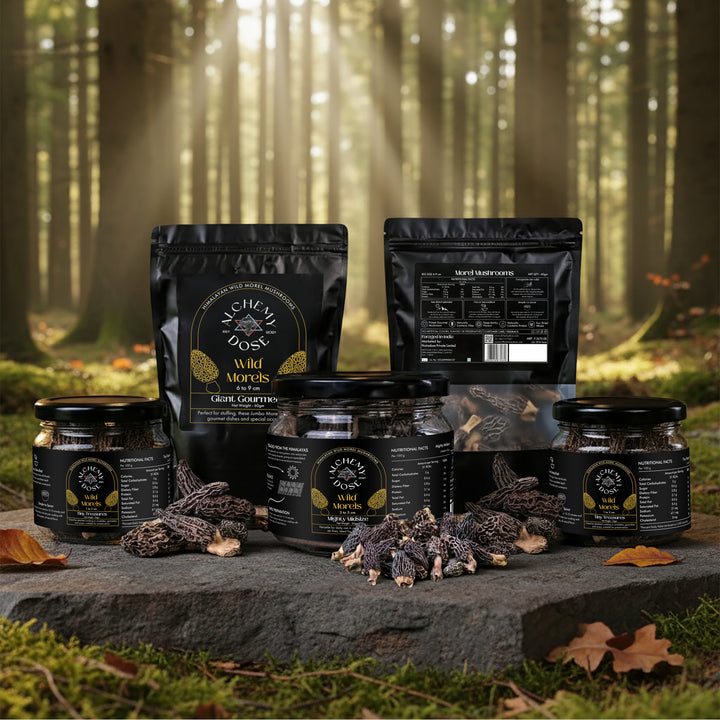
Wild Kashmiri Gucchi, the honeycombed Himalayan morel at the centre of India's first mushroom GI application.
What a GI Tag Actually Is
A Geographical Indication (GI) is a legal sign that ties a product to a specific place, because the product's qualities or reputation come from that origin. In India, GIs are granted under the Geographical Indications of Goods (Registration and Protection) Act, 1999, and administered by the Geographical Indications Registry in Chennai.
You already know GI products even if you do not know the term. Darjeeling tea, Basmati, Kashmir Pashmina, Alphonso mango, Mysore silk: each is a GI, meaning only produce from the defined region, meeting the defined description, may use the name commercially. A GI is about origin and identity, not about what a food does. It is a provenance mark, nothing more.
What a GI does and does not do
A granted GI protects a name tied to a place. It lets registered producers from the region use the name and gives them standing to act against imitators.
It is not a quality grade for an individual jar, and it is not a statement about a food beyond where it comes from. Origin, not outcome.
The Gucchi Application: Number 737, Doda
Here is the record, stated exactly, because most of what circulates online is vague. In 2021, a Geographical Indication application was filed with India's Geographical Indication Registry seeking GI status for Gucchi from Doda district, Jammu and Kashmir. The applicant is the Borderless Foundation, and the file carries application number 737.
The Gucchi GI application at a glance
Product
Gucchi, the wild Himalayan morel (Morchella)
Applicant
The Borderless Foundation
Region claimed
Doda district, Jammu and Kashmir
Where it sits
Final examination at the GI Registry in Chennai
Granted?
No. No formal grant has been issued yet.
Note the region claimed: Doda district, a single district in the Chenab valley. That detail matters later, because it is narrower than where gucchi is actually foraged.

Doda district in the Chenab valley, the single region named in application 737. The mushroom itself grows far wider.
Source
Geographical Indications Registry, Chennai, Government of India: application record for Gucchi, application number 737, applicant the Borderless Foundation, region Doda district, Jammu and Kashmir, filed 2021, status under examination.
Geographical Indications of Goods (Registration and Protection) Act, 1999.
Why It Has Not Been Granted Yet
A GI in India is not a form you file and receive by return post. An application moves through defined stages: filing, examination, an examination report, publication in the GI Journal, a window for opposition, and only then registration and grant. Any stage can raise queries that take months to resolve.
Gucchi's Geographical Indication application is in the final examination stage at the Registry in Chennai. Final examination is late in the process, but it is not the finish line. Until the Registry issues the certificate, there is no granted GI for gucchi, and the phrase "GI-tagged gucchi" describes an application, not a fact.
| Stage | What happens | Gucchi |
|---|
| Filed | Application submitted to the Registry | Done, 2021 |
| Examination | Registry reviews the claim and evidence | Here now, final examination |
| Published | Printed in the GI Journal for scrutiny | Pending |
| Opposition | Third parties may object | Pending |
| Registered and granted | Certificate issued, name protected | Not yet |
What This Means When You Buy
The practical consequence is simple and worth saying plainly: no seller in India can honestly call their gucchi "GI-certified" today, because no GI has been granted for gucchi to anyone. Any pack, listing or ad that prints a GI tag or a "GI-certified" line for gucchi right now is describing something that does not yet exist.
That does not make the mushroom any less real or any less Kashmiri. Wild gucchi is still hand-foraged in the Himalaya and graded by hand. It simply means the honest label today is wild-foraged with provenance you can trace, not a GI seal. Our own listing for Wild Himalayan Gucchi is written that way on purpose, and you can see the wider range in our gucchi and morels collection.
Honest gucchi claims today
- Wild-foraged in the Himalaya
- Kashmiri, Himachali or Uttarakhandi by source
- Hand-graded, whole dried morels
- Traceable provenance you can ask about
Claims no one can make yet
- "GI-certified" or "GI-tagged" gucchi
- A GI logo or seal on the pack
- "Protected origin" as a granted status
- Any GI number shown as a live registration
The Three-State Reality: Kashmir, Himachal, Uttarakhand
The pending application names Doda district alone. The mushroom does not read district boundaries. Wild gucchi is foraged across a tri-state Himalayan footprint, wider than any single district: the forests of Kashmir, Himachal Pradesh and Uttarakhand. Kashmiri morels are the most famous name in the trade, but the same wild morel is gathered on the slopes of all three.

Kashmir, Himachal Pradesh and Uttarakhand. Wild gucchi is foraged across all three, wider than any single district.
| Region | In the trade |
|---|
| Jammu and Kashmir | The best-known source; the Doda district GI claim sits here. Sold as Kashmiri morels. |
| Himachal Pradesh | Foraged widely across Himalayan forest belts; a major part of national supply. |
| Uttarakhand | Gathered in the Garhwal and Kumaon hills alongside other wild produce. |
This is why a Doda-only GI, if granted, would protect a name for one district while the culinary reality of Indian gucchi spans three states. Both things can be true at once, and an honest seller says which one it is selling.
Spotting a False "GI-Tagged" Claim
Because the reputation is valuable, the shortcut is tempting. Here is how to read a gucchi listing honestly.

The honest claim today is 'wild-foraged', not 'GI-certified'. Whole dried morels, provenance you can trace.
Read the label with these in hand
"GI-certified gucchi" or a GI logo: not possible today. No grant exists. Read it as marketing, not fact.
"GI-tagged from Doda": still an application, not a tag. The honest version is "from the region of a pending GI application".
"Wild-foraged Himalayan gucchi": this is the accurate claim, and the one to look for.
None of this is about doubting the mushroom. It is about matching the words to the paperwork. When the Registry grants the gucchi Geographical Indication, that will be a genuine, checkable milestone, and we will update this page the day it happens.
Frequently Asked Questions
Does gucchi have a GI tag yet?
No. A GI application (number 737) is in final examination at the Registry in Chennai, filed in 2021 by the Borderless Foundation for gucchi from Doda district. No grant has been issued, so no gucchi is GI-certified today.
Is gucchi really the world's most expensive mushroom?
It is routinely described that way, and it is among the most expensive culinary mushrooms sold anywhere, driven by wild foraging, short seasons and hand grading. We break the economics down in our guide to gucchi mushroom price in India.
Where does Indian gucchi come from?
Wild gucchi is foraged across three Himalayan states: Kashmir, Himachal Pradesh and Uttarakhand. Kashmiri morels are the best-known name, but the mushroom is gathered well beyond any single district.
How do I use gucchi in the kitchen?
Gucchi is a culinary morel, rehydrated and cooked like any dried morel. Our companion piece on gucchi benefits and how to cook it covers cleaning, soaking and cooking.
The Bottom Line
Gucchi is the closest any Indian mushroom has come to a Geographical Indication: one application, number 737, filed for Doda district in 2021, now in final examination. That is real, and it is why gucchi can fairly be called India's most protected mushroom in the making. It is also not finished, so "GI-certified gucchi" is not yet an honest claim for anyone.
Until the certificate exists, the truthful label is the simplest one: wild-foraged Himalayan gucchi, from Kashmir, Himachal Pradesh or Uttarakhand, sold as the culinary morel it is. That is a smaller claim than a GI seal, and it has the advantage of being exactly true today.
The mushrooms described here are foods and are not intended to diagnose, treat, cure or prevent any disease. Consult a qualified practitioner before use if pregnant, nursing, or managing a medical condition. Marketed by Nutradose Private Limited under FSSAI License No. 13326999000107.