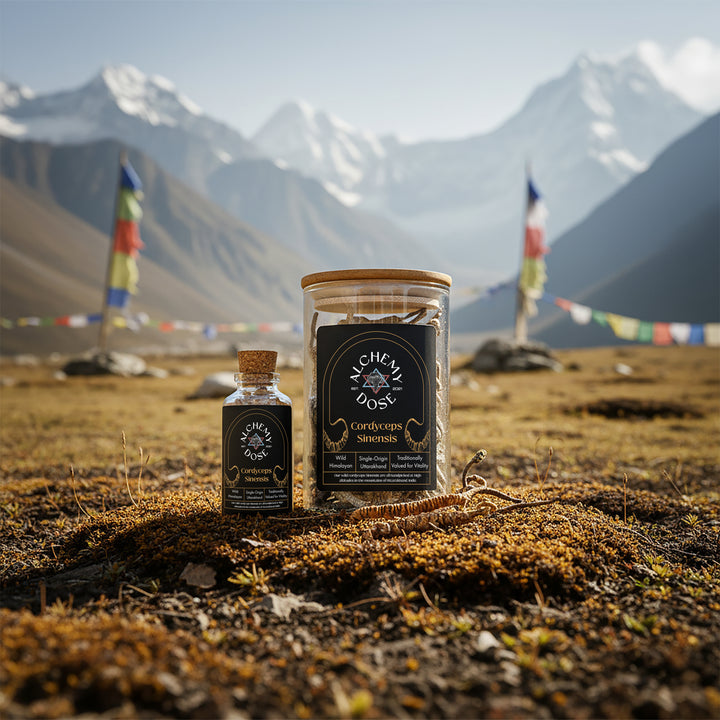
Keeda jadi and ashwagandha get shelved together as Indian tonics, and then compared as if they were two versions of the same idea. They are not. One is a fungus that grows out of a caterpillar on a Himalayan slope. The other is a root you can farm in a field. Before you can compare them honestly, you have to notice that they come from two different kingdoms of life.
This page is a plain, side-by-side comparison of what each one is, where it comes from, how rare it is, what it costs, and the shape of its place in tradition. It is not a page about what either one does in the body. We describe traditional use as tradition, hedged and factual, and we leave the health claims to nobody, because a food is not a medicine.

Two Indian tonics from two kingdoms: keeda jadi, a wild Himalayan fungus, and ashwagandha, a cultivated root.
Two Tonics, Two Kingdoms
Walk into any conversation about Indian tonics and these two names come up together, keeda jadi and ashwagandha, as if they were rivals on the same shelf. They are not really rivals, because they are not the same kind of thing at all. One is a fungus. The other is the root of a plant. They sit in two different kingdoms of life.
That single fact, a fungus on one side and a plant root on the other, is the most important line in this whole comparison. Almost every other difference, wild against cultivated, rare against common, costly against cheap, follows from it.
How to read this comparison
We compare what these two things are, not what they do. Where we describe traditional or Ayurvedic use, we are recording a cultural and historical fact, not a proven effect, and not a reason to expect any result. Neither keeda jadi nor ashwagandha is a medicine.
Keeda Jadi, or Yarsagumba
Ophiocordyceps sinensis, older name Cordyceps sinensis
A fungus that grows out of a caterpillar high in the Himalaya, hand-collected one piece at a time, and sold as whole dried specimens. Wild, scarce, and among the costliest natural products by weight.
Kingdom Fungi. Wild and foraged.
Ashwagandha
Withania somnifera, a shrub in the nightshade family
The dried root of a cultivated shrub, farmed across India and ground into a fine powder. Abundant, inexpensive, and a long-standing fixture of the Ayurvedic pantry.
Kingdom Plantae. Cultivated and farmed.
What Keeda Jadi Is
Keeda jadi is a Hindi name that means, more or less, insect herb, and it is a fair description. In Nepali and Tibetan it is yarsagumba, which translates as summer grass, winter worm. Both names point at the same strange thing.
The organism is a fungus, Ophiocordyceps sinensis, still widely sold under its older name Cordyceps sinensis. High on the Himalayan plateau, the fungus colonises the larva of a ghost moth underground. Through winter it slowly fills the caterpillar, and in spring it pushes a thin, dark fruiting body up through the soil. What foragers collect is the whole thing, fungus and mummified caterpillar together.
It is wild. It cannot be farmed in this true form, so every genuine piece is hand-collected, on foot, at altitude, in a short season. That is the root of everything that follows about its rarity and its price. We tell the fuller story of the names and the biology in our piece on keeda jadi and yarsagumba, and because people mix the two up, we also set out cordyceps militaris vs sinensis separately, since militaris is a different, cultivated cordyceps entirely.

Keeda jadi, or yarsagumba: the wild fungus and its mummified caterpillar host, hand-gathered on the high Himalaya.
Keeda jadi at a glance
Names
Keeda jadi in Hindi, roughly insect herb. Yarsagumba in Nepali and Tibetan, roughly summer grass, winter worm.
What it is
A fungus, Ophiocordyceps sinensis, that colonises a Himalayan caterpillar and fruits above the soil. Kingdom Fungi.
Source
Wild only. Hand-foraged in a short high-altitude season. Not farmed in this true form.
Cost and supply
Tiny supply, very high price. Routinely counted among the most expensive natural products by weight.
Typical form
Whole dried pieces, the fungus and its caterpillar host still intact.
What Ashwagandha Is
Ashwagandha is a plant, Withania somnifera, a small woody shrub in the nightshade family, the same broad family as the tomato and the potato. The name comes from words meaning the smell of a horse, a nod to the earthy odour of the fresh root.
And the root is the point. The part that is used, dried and ground into a powder, is the root, not a fruit and not a fungus. Ashwagandha is a cultivated crop, sown and harvested like any other, grown across India in quantity. Where keeda jadi is gathered a piece at a time, ashwagandha is farmed by the tonne.
It is one of the oldest and most familiar plants in the Ayurvedic pantry. Classical texts group it as a rasayana, a traditional category of rejuvenative tonics. That is a description of where it sits within a traditional system, recorded as history, not a statement about what it does.

Ashwagandha: the dried root of a cultivated shrub, ground to a powder called churna. Farmed by the tonne.
A word on adaptogen
You will see ashwagandha, and sometimes keeda jadi, filed under a category some call adaptogens. Read that as a traditional-style label that became popular in modern wellness writing, a shelf these things get placed on, not a statement that either one has a proven effect on anything.
Ashwagandha at a glance
Name
Ashwagandha, from words meaning the smell of a horse, after the odour of the fresh root.
What it is
A plant, Withania somnifera, a woody shrub in the nightshade family. The root is the part used. Kingdom Plantae.
Source
Cultivated. A field crop grown across India and harvested in quantity.
Cost and supply
Abundant and inexpensive, available year-round.
Typical form
Dried root, usually ground to a powder called churna, or made into an extract.
Fungus vs Root: The Core Difference
If you remember one thing from this page, remember that you are comparing a fungus to a plant root. Here is the entire comparison on a single grid.
| | Keeda Jadi (Yarsagumba) | Ashwagandha |
|---|
| What it is | A fungus that grows out of a caterpillar | A plant, and the part used is the root |
| Kingdom | Fungi | Plantae, the nightshade family |
| Scientific name | Ophiocordyceps sinensis, older name Cordyceps sinensis | Withania somnifera |
| Part used | The whole fungus, with its caterpillar host attached | The dried root, ground to a powder |
| Source | Wild, hand-foraged | Cultivated, farmed |
| Where it comes from | High Himalayan meadows, roughly 3,500 metres and above | Farmland across India and beyond |
| Supply | Tiny, seasonal, and under pressure | Large and available year-round |
| Relative cost | Among the most expensive natural products by weight | Inexpensive and everyday |
| Typical form | Whole dried pieces | Powder, called churna, or an extract |
| Place in tradition | A rare, high-status tonic in Himalayan, Tibetan and Chinese tradition | A rasayana, a rejuvenative-tonic category, in Ayurveda |
Read down the two columns and the pattern is clear. Keeda jadi is wild, whole, rare and dear. Ashwagandha is cultivated, ground, common and cheap. Neither of those columns is a scorecard. They describe two different things, not a winner.

Wild, whole, rare and dear on one side; cultivated, ground, common and cheap on the other. Two different things.
Wild vs Cultivated, and the Cost
The price gap between these two is enormous, and it is worth understanding where it comes from, because it is not a mystery and it is not a measure of quality.
Keeda jadi cannot be commercially farmed in its wild form. Every real piece is foraged by hand, high in the mountains, during a brief window each year, by people who comb the slopes bent double looking for a fruiting body a few centimetres tall. Supply is capped by nature and, in many areas, is under real pressure. When something is that scarce and that laborious to gather, the price climbs, and keeda jadi is routinely counted among the most expensive natural products on earth by weight.
Ashwagandha is the opposite story. It is a hardy agricultural crop. Plant more, harvest more. Supply scales with demand, so the price stays low and the root stays on every shelf. Same country, same broad idea of a traditional tonic, completely different economics.
Price is not proof
That keeda jadi is rare and costly, and ashwagandha is cheap and common, is a fact about supply, season and labour. It is not a fact about what either one does for anyone. A high price buys scarcity, not an outcome.
How Each Is Traditionally Used
Both of these carry long traditional reputations, and this is exactly the point where honest description can slide into an implied promise. We are going to stay on the description side of that line, and we would encourage you to be suspicious of anyone who does not.
In Himalayan, Tibetan and traditional Chinese settings, keeda jadi has for centuries been regarded as a rare and high-status tonic, something reserved for special use in large part because so little of it has ever existed. That tells you about its cultural standing. It does not tell you about any effect.
In Ayurveda, ashwagandha root is classed as a rasayana and has traditionally been taken as a powder, often stirred into warm milk with a little ghee, as part of that system. Again, that is a record of how a tradition uses a plant, not a proven outcome, and not a recommendation from us.
What is fair to say
- They are different kingdoms. One is a fungus, the other a plant root
- One is wild, one is farmed. Keeda jadi is foraged, ashwagandha is cultivated
- One is rare, one is common. And the price gap follows from that
- Both are traditional tonics. Each has a long, documented place in its own tradition
What no one can honestly claim
- That either is a medicine. Both are foods
- That tradition is proof. A long history of use is not evidence of an effect
- That the costly one must be better. Rarity is about supply, not about the body
- Any specific effect. We make no such claim for either ingredient
Which One Your Interest Points To
Because neither one is a medicine, the honest question is not which of them works. It is which of them you are actually curious about.
If you are drawn to the wild and the rare, to a foraged Himalayan fungus with an unlikely life story and a price to match, your interest points to keeda jadi. If you are drawn to the everyday and the accessible, to a cultivated root that has been part of Indian kitchens and Ayurvedic practice for generations and costs very little, your interest points to ashwagandha.
They are not competitors so much as opposites, a scarce wild fungus and an abundant cultivated root, and plenty of people are interested in both for precisely the reasons they differ. If it is the Himalayan fungus that has your attention, ours is a Wild Himalayan Cordyceps Sinensis, and you can browse the wider range in the keeda jadi and cordyceps collection.
Frequently Asked Questions
Is keeda jadi the same as cordyceps?
It is a cordyceps. Keeda jadi is the wild Himalayan species Ophiocordyceps sinensis, long known as Cordyceps sinensis. Cordyceps is a large group of fungi, though, and the cultivated Cordyceps militaris is a different species, not the same thing as the wild Himalayan one.
Is ashwagandha a mushroom?
No. Ashwagandha is a plant root, Withania somnifera, from the nightshade family. In this comparison, keeda jadi is the fungus and ashwagandha is the plant. That is the whole point of putting them side by side.
Which is more expensive, keeda jadi or ashwagandha?
Keeda jadi, by a very wide margin. It is wild, foraged and scarce, while ashwagandha is a farmed crop grown in quantity. The gap reflects supply and labour, not a difference in what either one does.
Is either one an adaptogen?
Adaptogen is a traditional-style category label, popularised in modern wellness writing, that ashwagandha is often filed under and keeda jadi is sometimes attached to. It names a shelf, not a proven effect, so read it as a way of grouping traditional tonics rather than a claim about the body.
Can I take both?
This is a comparison of what the two ingredients are, framed as food and tradition, not personal advice. We make no health or usage claims for either. Anyone who is pregnant, nursing, on medication, or managing a medical condition should speak with a qualified practitioner before adding any supplement.
The mushrooms described here are foods and are not intended to diagnose, treat, cure or prevent any disease. Consult a qualified practitioner before use if pregnant, nursing, or managing a medical condition. Marketed by Nutradose Private Limited under FSSAI License No. 13326999000107.