




Match what you are interested in to the mushroom people traditionally reach for, by composition, not by claim
Four kinds of interest, four traditions. Deep work, mornings and movement, winding down, and an everyday base, mapped to Lion's Mane, Cordyceps, Reishi, and our five-mushroom coffee blend.
There is no single best functional mushroom, only the one that fits what you are actually interested in. This page is a router. You name the moment in your day you want to build a small ritual around, and it points you at the mushroom people have traditionally reached for at that moment, and at the compound that mushroom is known to contain.
What this page will not do is tell you that any mushroom does anything to your body. It maps interest to tradition and composition, what is in the jar and when people have historically taken it. The effects, if any, are not ours to promise, and we explain exactly why near the end.

Start with honesty about your own day. Not with a symptom, and not with a fix you are hoping to buy, but with a moment you would like to attach a ritual to. Almost everyone lands in one of four.
Once you know which moment is yours, the table below is the whole router. The left column is your interest. The middle column is the mushroom tradition has attached to that moment. The right column is the named compound that mushroom is known for, so you can recognise it on a label instead of taking a brand's word for it.
| Your interest | Traditionally reached for | The composition behind it |
|---|---|---|
| Focused, desk-bound work | Lion's Mane, Hericium erinaceus | Hericenones |
| Mornings and movement | Cordyceps militaris, and wild Keeda Jadi | Cordycepin |
| Evenings and winding down | Reishi, Ganoderma lucidum | Triterpenes |
| An everyday base, no goal in particular | Our five-mushroom coffee, or Turkey Tail | Beta-glucans, polysaccharides |
The left column is tradition, why have people historically reached for this mushroom. The right column is chemistry, the named compound that mushroom is known to contain. Neither column is a promise about your body. It is a map from your interest to a jar, and nothing more than that.
If your day is built around long, unbroken stretches at a desk, writing, coding, studying, the mushroom tradition attaches to that moment is Lion's Mane, Hericium erinaceus, the white, cascading fungus that looks like a frozen waterfall.
What is in it is a pair of compound families you will not see named on most labels. Hericenones, which sit in the fruiting body, and erinacines, which sit in the mycelium. They are the reason Lion's Mane became the mushroom of the desk, the jar people keep next to the keyboard rather than in the gym bag. We took the chemistry of those two compound families apart in detail on the Lion's Mane page.
Hericium erinaceus, whole fruiting body, dual-extracted in water and ethanol.
Traditionally the mushroom people keep within reach of the keyboard. Its named compounds, hericenones and erinacines, are what set it apart on a certificate of analysis, not any promise about how a workday feels.
If that is your moment, our Lion's Mane sits in a small range built around exactly it: Lion's Mane for focused work.

If your day opens with movement, an early workout, a run, physical work, the tradition points to Cordyceps. Here there are two of them, and they are not the same thing.
Cordyceps militaris is the bright orange, cultivated species, grown on a substrate and prized because it can be produced to a consistent, testable specification. Its signature compound is cordycepin, and we went deep on that molecule and the research around the species on the Cordyceps militaris page.
Keeda Jadi, also called Yarsagumba, is the wild original, Cordyceps sinensis, the strange caterpillar fungus of the high Himalaya that mountain communities have gathered and traded for centuries. It is rarer, stranger, and carries a tradition entirely its own, which we tell on the Keeda Jadi page. Both are mushrooms of the morning, the ones tradition places before the body is asked to work, not the ones kept at a desk.
Cordyceps militaris, cultivated, and wild Cordyceps sinensis from the Himalaya.
Two mushrooms, one moment: the start of a physically active day. The cultivated militaris is grown to a testable spec and known for cordycepin. The wild sinensis carries a Himalayan foraging tradition centuries old.
The pair we point people toward for that slot lives here: Cordyceps for mornings.

If the moment you care about is the end of the day, the mushroom with the longest ritual tradition is Reishi, Ganoderma lucidum, the lacquered, wine-dark bracket the Chinese called the mushroom of a thousand years.
What defines Reishi chemically is its triterpenes, the bitter compounds that give it its unmistakable taste and that, unlike the beta-glucans in most mushrooms, are not water-soluble. That is precisely why an honest Reishi is dual-extracted in water and ethanol rather than simply steeped, and we explain that extraction, and the chemistry behind it, on the Reishi page.
Reishi is traditionally an evening ritual. A bitter, warm cup that marks the end of a working day. That is all we will call it.
It is not a sleep product, and we make no claim, none, about sleep or about anything that happens after you put the cup down. The ritual is the point. Everything past that is not ours to promise.
Ganoderma lucidum, dual-extracted in water and ethanol.
The mushroom with the oldest ritual reputation, taken as a bitter evening cup. Its triterpenes are the reason it must be dual-extracted, and the reason it tastes the way it does. A ritual, described as a ritual.

Not everyone is trying to solve a moment. Plenty of people simply want one honest mushroom ritual in the day and would rather not think about it again. For them the answer is not a single specialist but a foundation.
The simplest version is Turkey Tail, Trametes versicolor, the most studied and most beta-glucan-rich fungus in the whole cabinet, taken as a plain hot-water extract. We wrote about what is, and is not, in a Turkey Tail jar on the Turkey Tail page.
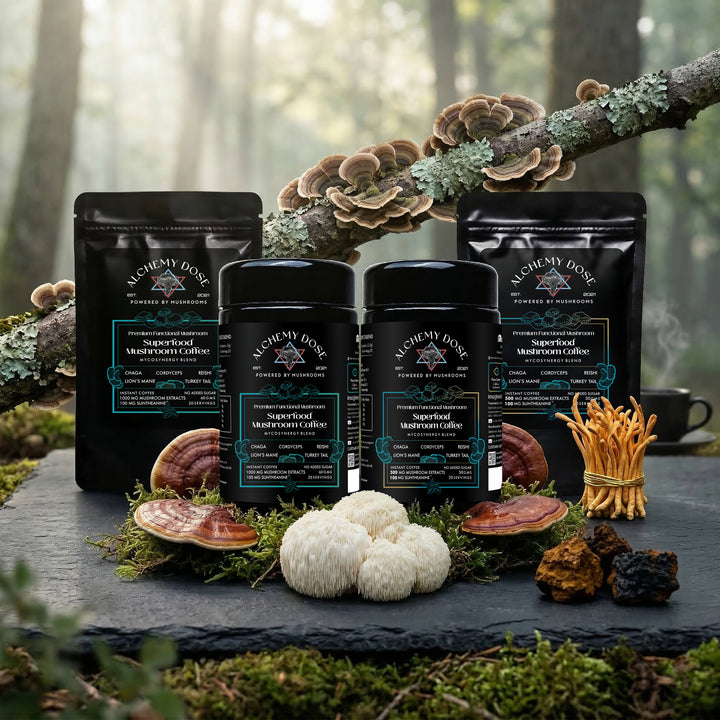
The easiest version is our Super Shroom Coffee, the MycoSynergy blend, built into a coffee so the ritual attaches to something you already do. It carries five mushroom fruiting-body extracts, Lion's Mane, Cordyceps militaris, Reishi, Chaga and Turkey Tail, on an Arabica base, with 100 mg of Suntheanine L-theanine per serving. One teaspoon, hot or cold. It is the no-decision answer to the whole router.
It is built as three groupings rather than five names in a row: the caffeine and Suntheanine pairing, then Lion's Mane and Cordyceps for their hericenones and cordycepin, then Reishi, Chaga and Turkey Tail for their beta-glucans and polysaccharides. The one part with human trials behind it is that first pairing. The L-theanine and caffeine combination has been examined for attention switching and self-reported alertness in double-blind trials (Owen 2008, PMID 18681988; Giesbrecht 2010, PMID 21040626), both funded by Unilever R&D. That is what those studies examined, not a promise about your cup.
Chaga, Inonotus obliquus, is the fifth of those extracts: the black, charcoal-crusted fungus that grows on birch in cold boreal forests, known for betulin, melanin, polysaccharides and beta-glucans. We keep it as one of the five in the blend and describe the species, not an outcome, on our Chaga page.

You have just read four sections that carefully never told you what any mushroom does. That was not an accident, and it is worth explaining, because the reason is the whole reason to trust the rest of the page.
We sell foods, not medicines. Under India's food rules a food may not be advertised as though it diagnoses, treats, cures, or prevents anything, and honestly, the evidence for a plain food extract usually would not support such a claim even if the rules allowed it. Most of the impressive research attached to these mushrooms was done on specific, standardised, often patented preparations, not on the generic extract in a jar. That research belongs to those preparations. It does not transfer to a food simply because the species on the label matches.
So we do the only honest thing available. We tell you the species, the compound, the extraction, the per-batch number, and the tradition. Then we stop. What it does, if anything, is between you, your body, and a qualified practitioner, and we are genuinely not permitted to stand in that space, nor would we want to.
There is no best, only best-matched. Pick the moment in your day you want a ritual around, focused work, mornings, evenings, or just an everyday base, and the table near the top points you at the mushroom tradition attaches to that moment. Best is a marketing word. Matched is an honest one.
People do. A Lion's Mane at the desk and a Reishi cup in the evening are different rituals at different hours, and nothing about them competes. This is about matching a mushroom to a moment, so more moments simply means more mushrooms. We still make no claim about what any of them, alone or together, does.
One is cultivated, one is wild. Cordyceps militaris is the bright orange species grown to a consistent, testable specification. Keeda Jadi, or Yarsagumba, is wild Cordyceps sinensis, the Himalayan caterpillar fungus gathered by hand. Same morning tradition, very different origins, and we cover both in their own pages.
No, it is a different intent. A specialist extract is for someone building a ritual around one specific moment. The five-mushroom blend in Super Shroom Coffee, Lion's Mane, Cordyceps, Reishi, Chaga and Turkey Tail in one cup, is for someone who wants one daily habit and no decisions. Neither is better than the other. They answer different questions.
Yes. Our Super Shroom Coffee blends five mushroom fruiting-body extracts, Lion's Mane, Cordyceps militaris, Reishi, Chaga and Turkey Tail, with 100 mg of Suntheanine L-theanine, on an Arabica base. Chaga, Inonotus obliquus, is the black birch fungus known for betulin and polysaccharides. We describe what is in the cup, not what it does.
Because they are foods, not medicines, and Indian food law is clear that a food may not be sold as though it diagnoses, treats, cures, or prevents anything. Beyond the law, the honest position is that the research people quote usually belongs to specific pharmaceutical preparations, not to a generic extract. We would rather tell you exactly what is in the jar than borrow a promise that was never about our product.
The mushrooms described here are foods and are not intended to diagnose, treat, cure or prevent any disease. Consult a qualified practitioner before use if pregnant, nursing, or managing a medical condition. Marketed by Nutradose Private Limited under FSSAI License No. 13326999000107.


